How Emerging Technologies Are Shaping the Next Generation of Scientific Discovery
Laboratory science is entering one of the most transformative periods in its history. Rapid advances in automation, artificial intelligence, robotics, computational biology, high resolution analytical instrumentation, genomics, and data science are fundamentally changing how scientific research is designed, conducted, and interpreted. Modern laboratories are evolving from traditional experimental environments into highly integrated research ecosystems where sophisticated technologies work alongside scientists to generate more accurate measurements, process larger volumes of data, and answer increasingly complex biological questions. These developments are not replacing the scientific method; rather, they are expanding its capabilities and allowing researchers to investigate the natural world with a level of precision that was unimaginable only a few decades ago.
The future of laboratory science will be defined by interdisciplinary collaboration. Chemists, molecular biologists, neuroscientists, engineers, physicists, computer scientists, mathematicians, statisticians, and data specialists are working together to develop technologies that bridge the boundaries between scientific disciplines. This collaborative model is accelerating discovery across chemistry, biology, neuroscience, genetics, pharmacology, environmental science, and natural product research, creating opportunities for scientific progress that extend far beyond any individual field of study.
Automation and the Modern Research Laboratory
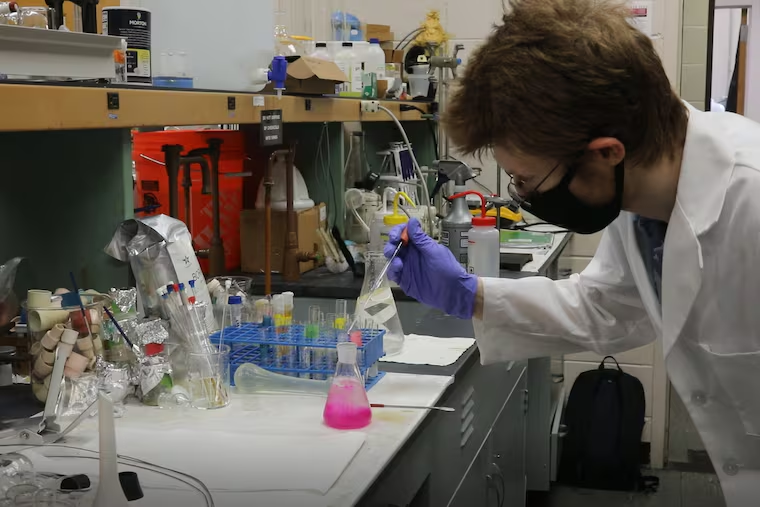
Automation has become one of the most significant innovations in laboratory science. Modern research facilities increasingly rely on automated instruments capable of performing highly standardized analytical procedures with exceptional consistency and precision. Robotic systems now assist with sample preparation, liquid handling, analytical workflows, laboratory monitoring, and digital documentation, allowing researchers to process large numbers of samples while reducing procedural variability and improving overall data quality.
The advantages of automation extend beyond efficiency alone. Standardized robotic workflows reduce the potential for manual variation, strengthen reproducibility, and allow laboratories to maintain consistent analytical performance over extended periods of investigation. Scientists remain responsible for experimental design, scientific interpretation, and methodological development, while automation supports the accurate execution of routine laboratory procedures. This partnership between human expertise and advanced technology represents one of the defining characteristics of twenty first century scientific research.
Artificial Intelligence Accelerating Discovery
Artificial intelligence is expected to play an even greater role in future laboratory environments. Machine learning algorithms are becoming increasingly capable of recognizing complex biological patterns, interpreting analytical data, predicting molecular interactions, and assisting researchers in developing sophisticated computational models. Rather than replacing scientific judgment, these technologies provide powerful analytical support that enables scientists to evaluate information with greater speed, consistency, and precision.
Future AI systems will likely integrate directly with laboratory instrumentation, allowing real time analysis of experimental data as investigations are being conducted. Intelligent computational platforms may assist in identifying unexpected observations, optimizing analytical workflows, monitoring instrument performance, and generating preliminary statistical analyses. These capabilities will allow researchers to devote more time to scientific reasoning, interdisciplinary collaboration, and the development of new research questions while computational systems manage increasingly complex analytical tasks.
The Expansion of Multiomics Science
One of the most exciting frontiers in laboratory research is the continued expansion of multiomics, an integrated scientific approach that combines genomics, transcriptomics, proteomics, metabolomics, lipidomics, and other molecular disciplines to create a comprehensive understanding of biological systems. Rather than examining a single biological process in isolation, multiomics investigates how genes, proteins, metabolites, and cellular pathways interact within living organisms to produce complex biological functions.
Advances in sequencing technologies, high resolution analytical chemistry, computational biology, and bioinformatics have made large scale multiomics research increasingly practical. Scientists are now able to integrate diverse biological datasets into unified computational models that reveal relationships extending across multiple levels of biological organization. This systems level perspective is transforming modern biology by providing a more complete understanding of the extraordinary complexity that defines living organisms.
Precision Instrumentation and Analytical Innovation
Future laboratory science will continue to benefit from increasingly sophisticated analytical instruments capable of measuring biological and chemical systems with exceptional sensitivity. Next generation mass spectrometers, ultra high field magnetic resonance systems, advanced electron microscopy, high resolution imaging platforms, and emerging quantum sensing technologies promise to expand scientific observation far beyond current capabilities. These innovations will allow researchers to investigate molecular interactions, cellular organization, and biochemical processes with unprecedented detail.
Precision instrumentation also enhances reproducibility by improving measurement accuracy and reducing analytical uncertainty. As laboratory technologies continue evolving, scientists will be able to compare experimental findings with greater confidence while investigating increasingly subtle biological phenomena that were previously beyond the limits of available instrumentation.
Global Collaboration Driving Scientific Progress
The laboratory of the future will be more interconnected than ever before. Digital communication platforms, secure cloud computing, international research networks, open scientific databases, and collaborative computational infrastructure are enabling scientists from different countries and disciplines to work together in real time. Researchers can now share analytical methods, computational models, genomic information, imaging datasets, and experimental findings across continents, greatly accelerating the pace of scientific discovery.
This global exchange of knowledge promotes transparency, strengthens reproducibility, and encourages the independent verification of scientific results. Collaborative research environments also foster innovation by bringing together specialists with complementary expertise, allowing increasingly ambitious scientific questions to be addressed through interdisciplinary investigation.
Looking Beyond Today’s Scientific Horizon
The future of laboratory science will not be defined by a single technological breakthrough but by the continued integration of intelligent automation, advanced computation, precision instrumentation, interdisciplinary collaboration, and evidence based scientific methodology. As technologies continue evolving, researchers will gain unprecedented opportunities to investigate the molecular, cellular, and neurological foundations of life while expanding our understanding of chemistry, biology, neuroscience, genetics, and the natural world.
Despite these extraordinary technological advances, the principles that define excellent science will remain unchanged. Careful observation, rigorous methodology, ethical responsibility, transparency, reproducibility, peer review, and critical thinking will continue guiding every meaningful scientific discovery. The laboratories of tomorrow may look dramatically different from those of today, but their ultimate purpose will remain the same: to generate reliable knowledge through disciplined investigation and to deepen humanity’s understanding of the remarkable complexity of the world around us.