Exploring One of Nature’s Most Remarkable Groups of Fungi
Psilocybin mushrooms represent one of the most extensively studied groups of fungi within modern mycology and natural product research. Distributed across numerous regions of the world, these mushrooms belong to several different genera and encompass hundreds of scientifically documented species that vary considerably in appearance, habitat, ecological function, and evolutionary history. Although they are often discussed collectively, psilocybin producing fungi display an extraordinary level of biological diversity that continues to fascinate mycologists, ecologists, chemists, and evolutionary biologists alike. Their study contributes not only to psychedelic science but also to a broader understanding of fungal biodiversity and the remarkable complexity of natural ecosystems.
Scientific interest in these fungi extends far beyond the compounds they naturally produce. Researchers investigate their taxonomy, life cycles, genetics, environmental relationships, biochemical pathways, and ecological importance to better understand how fungi evolve and interact with the natural world. As advances in molecular biology and DNA sequencing continue to refine fungal classification, scientists are discovering new relationships between species while expanding knowledge of one of the largest and most diverse kingdoms of life.
Understanding Fungal Diversity
The fungal kingdom is one of the most biologically diverse groups of organisms on Earth, comprising millions of species that occupy nearly every terrestrial ecosystem. Within this immense kingdom, psilocybin producing mushrooms represent only a small but scientifically significant group. Most belong to the genus Psilocybe, although species capable of producing psilocybin have also been identified in genera including Panaeolus, Gymnopilus, Pluteus, Inocybe, Conocybe, and Pholiotina. Each genus possesses distinctive structural characteristics, ecological preferences, and evolutionary histories that contribute to the remarkable diversity observed among these fungi.
Modern taxonomy continues to refine how these species are classified. DNA sequencing and molecular phylogenetics have transformed fungal science by allowing researchers to compare genetic relationships with far greater precision than traditional morphology alone. These advances have led to the reclassification of numerous species while improving scientific understanding of fungal evolution, biodiversity, and global distribution.
Habitats Across the Natural World
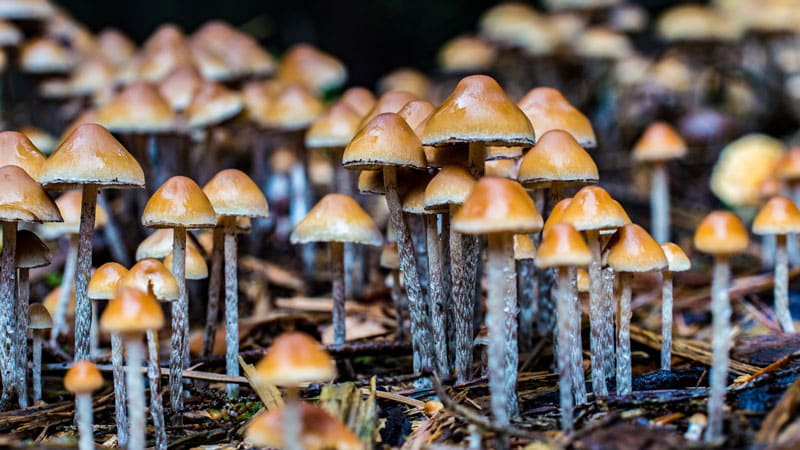
Psilocybin producing mushrooms occupy an impressive variety of natural environments. Different species have evolved to thrive within forests, grasslands, subtropical regions, temperate woodlands, mountainous ecosystems, and humid tropical environments. Some grow on decomposing wood, others develop in nutrient rich soils, while certain species are closely associated with grassland ecosystems and decaying plant material. These habitat preferences reflect highly specialized ecological adaptations that have developed over millions of years through natural selection.
Environmental conditions such as temperature, humidity, rainfall, soil composition, altitude, and seasonal variation all influence fungal growth and distribution. Mycologists study these ecological relationships to better understand how fungi contribute to nutrient cycling, decomposition, and ecosystem stability. By breaking down organic matter and recycling essential nutrients, fungi perform indispensable ecological functions that support the health and resilience of natural environments worldwide.
The Biology Behind Their Life Cycle
Like all mushrooms, psilocybin producing species represent only the reproductive stage of a much larger fungal organism. Beneath the soil, wood, or forest litter exists an extensive network of microscopic filaments known as mycelium. This hidden structure absorbs nutrients, decomposes organic material, and interacts continuously with surrounding microorganisms, plant roots, and soil ecosystems. Under suitable environmental conditions, the mycelium produces fruiting bodies that emerge above the surface and release spores, completing the reproductive cycle.
The study of fungal development has become increasingly sophisticated through advances in microscopy, molecular genetics, and developmental biology. Scientists continue investigating how environmental signals regulate spore germination, mycelial growth, enzyme production, and fruiting body formation. These discoveries contribute to a broader understanding of fungal biology while highlighting the remarkable adaptability of organisms within the fungal kingdom.
Modern Mycology and Scientific Discovery
The scientific study of fungi has advanced dramatically during the past several decades. High resolution microscopy, genomic sequencing, metabolomics, and analytical chemistry now enable researchers to investigate fungal organisms at cellular, molecular, and genetic levels. These technologies reveal how fungi synthesize complex natural compounds, respond to environmental changes, and evolve through genetic adaptation. Modern mycology has therefore become an interdisciplinary science that integrates ecology, microbiology, molecular biology, evolutionary biology, and natural product chemistry.
International collaboration has further accelerated fungal research by allowing scientists to compare specimens collected from different continents, establish standardized taxonomic databases, and document previously unknown species. Every new discovery strengthens scientific understanding of fungal biodiversity while expanding knowledge of ecological processes that influence life across terrestrial ecosystems.
Why Fungal Diversity Matters
Understanding the diversity of psilocybin producing mushrooms extends beyond the study of individual species. These fungi provide valuable insight into evolution, ecosystem dynamics, genetics, biodiversity, and the extraordinary capacity of nature to generate complex biological systems. Their ecological roles demonstrate the importance of fungi as fundamental components of healthy environments, while their scientific investigation continues contributing to broader fields including mycology, botany, environmental science, molecular biology, and natural product chemistry.
As new technologies continue improving species identification and ecological research, scientists are likely to discover additional fungal diversity that remains undocumented. Every newly described species and every refined taxonomic relationship contributes another piece to the larger picture of fungal evolution, reinforcing the importance of preserving biodiversity while advancing our understanding of one of the most fascinating kingdoms in the natural world.