
Understanding One of Central Africa’s Most Remarkable Botanical Species
Among the many plants investigated within ethnobotany and natural product science, Tabernanthe iboga occupies a distinctive position because of its unique botanical characteristics, ecological adaptations, and complex natural chemistry. Native to the tropical rainforests of Central Africa, this evergreen shrub belongs to the Apocynaceae family, a large botanical family known for its extraordinary diversity of biologically active plant species. While Tabernanthe iboga has attracted considerable scientific attention because of the naturally occurring alkaloids it produces, researchers increasingly recognize that its significance extends far beyond chemistry alone. The species provides valuable opportunities to investigate rainforest ecology, plant evolution, biodiversity, genetics, and the intricate biological processes that enable plants to synthesize highly specialized natural compounds.
Modern scientific research approaches Tabernanthe iboga through an interdisciplinary framework that combines botany, ecology, molecular biology, phytochemistry, conservation science, and ethnobotany. By examining the plant within its natural environment and evolutionary context, scientists continue to uncover important information about its biological development, ecological relationships, and place within one of Africa’s most biologically diverse rainforest ecosystems.
The Botanical Identity of Tabernanthe iboga
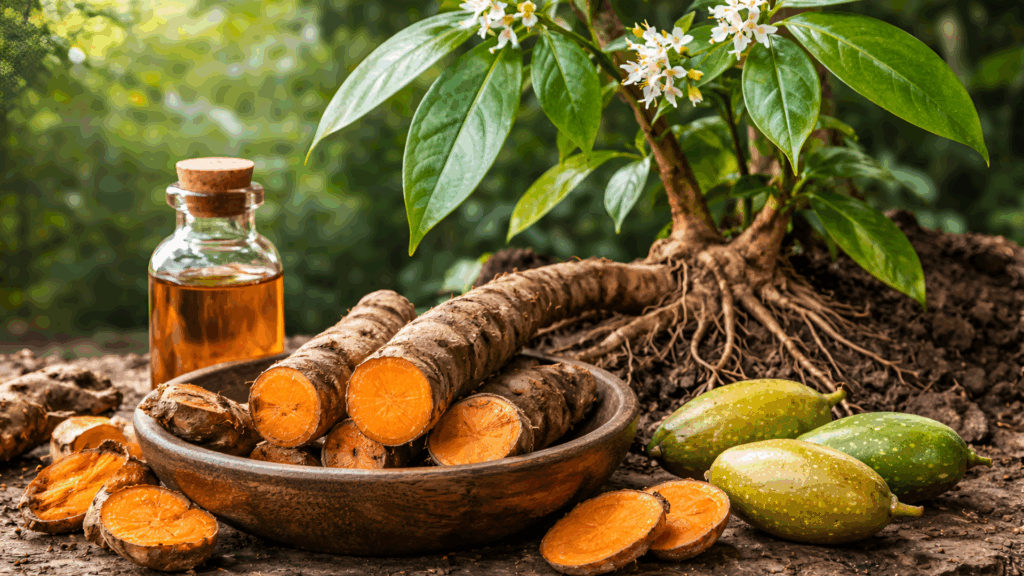
Tabernanthe iboga is an evergreen understory shrub naturally distributed across the humid tropical forests of countries including Gabon, Cameroon, Equatorial Guinea, the Republic of the Congo, and neighboring regions of Central Africa. It thrives beneath the rainforest canopy, where filtered sunlight, abundant rainfall, nutrient rich soils, and stable humidity create conditions that support its slow and steady development. Its glossy leaves, fragrant flowers, and brightly colored fruit distinguish it within its native habitat while reflecting numerous evolutionary adaptations that enable survival within dense tropical forests.
Botanists study the species to better understand its reproductive biology, growth cycles, genetic diversity, and taxonomic relationships within the Apocynaceae family. Advances in molecular genetics have refined scientific classification by revealing evolutionary connections with related plant species, demonstrating how millions of years of adaptation have shaped the remarkable diversity found throughout tropical ecosystems.
Natural Chemistry Within Living Plants
Like many rainforest species, Tabernanthe iboga produces a diverse collection of naturally occurring alkaloids through sophisticated biochemical pathways that have evolved over long periods of evolutionary history. These compounds are synthesized through carefully regulated enzymatic processes that convert simple biological molecules into structurally complex natural products. Scientists investigate these metabolic pathways to better understand how plants generate chemical diversity and how secondary metabolites contribute to ecological survival.
Phytochemistry, the scientific study of plant derived compounds, has become one of the most important disciplines contributing to the understanding of Tabernanthe iboga. Using advanced analytical technologies such as High Performance Liquid Chromatography, Mass Spectrometry, Nuclear Magnetic Resonance spectroscopy, and metabolomic analysis, researchers continue identifying naturally occurring compounds while expanding knowledge of plant biochemistry and molecular evolution.
Ecology and Rainforest Biodiversity
The tropical rainforests of Central Africa represent one of the world’s richest reservoirs of biological diversity. Within these ecosystems, Tabernanthe iboga exists alongside thousands of plant species, fungi, insects, microorganisms, mammals, reptiles, and birds that together form highly interconnected ecological communities. Every species contributes to nutrient cycling, pollination, seed dispersal, forest regeneration, and ecosystem stability, illustrating the remarkable complexity of rainforest ecology.
Environmental scientists investigate how soil composition, rainfall, temperature, humidity, microbial interactions, and surrounding vegetation influence the growth and long term survival of rainforest plants. These ecological relationships help explain how species adapt to changing environmental conditions while contributing to the resilience of tropical ecosystems. Understanding these interactions has become increasingly important as conservation biology seeks to protect biodiversity across vulnerable rainforest habitats.
Ethnobotany and Traditional Ecological Knowledge
Ethnobotany examines the historical relationships between human societies and plants, providing valuable insight into how communities have observed, classified, and understood biodiversity over generations. Throughout Central Africa, traditional ecological knowledge has contributed significantly to botanical understanding by documenting plant characteristics, habitat preferences, seasonal growth patterns, and ecological relationships within rainforest environments. Contemporary researchers recognize that this accumulated knowledge represents an important source of information that complements modern botanical science.
Today, ethnobotanical studies increasingly emphasize collaboration, cultural respect, and responsible documentation. Scientists work alongside local experts and Indigenous knowledge holders to improve understanding of plant diversity while ensuring that traditional knowledge is acknowledged within broader scientific research. This partnership strengthens both conservation efforts and botanical investigation while promoting a more comprehensive understanding of tropical biodiversity.
The Continuing Future of Botanical Research
Scientific interest in Tabernanthe iboga continues to expand as new technologies improve the study of plant biology, genetics, ecology, and natural product chemistry. Genomic sequencing, metabolomics, structural biology, artificial intelligence, and computational plant science now allow researchers to investigate biological systems with remarkable precision while revealing relationships that were previously impossible to observe. These advances continue improving scientific understanding of how plants evolve, adapt, and contribute to the extraordinary diversity of life within tropical forests.
As conservation, biodiversity research, and botanical science continue to advance together, Tabernanthe iboga remains an important example of how a single plant species can contribute to numerous scientific disciplines. Its study demonstrates the value of integrating ecology, chemistry, molecular biology, ethnobotany, and evolutionary science to build a richer understanding of the natural world and the remarkable complexity of Earth’s tropical ecosystems.