
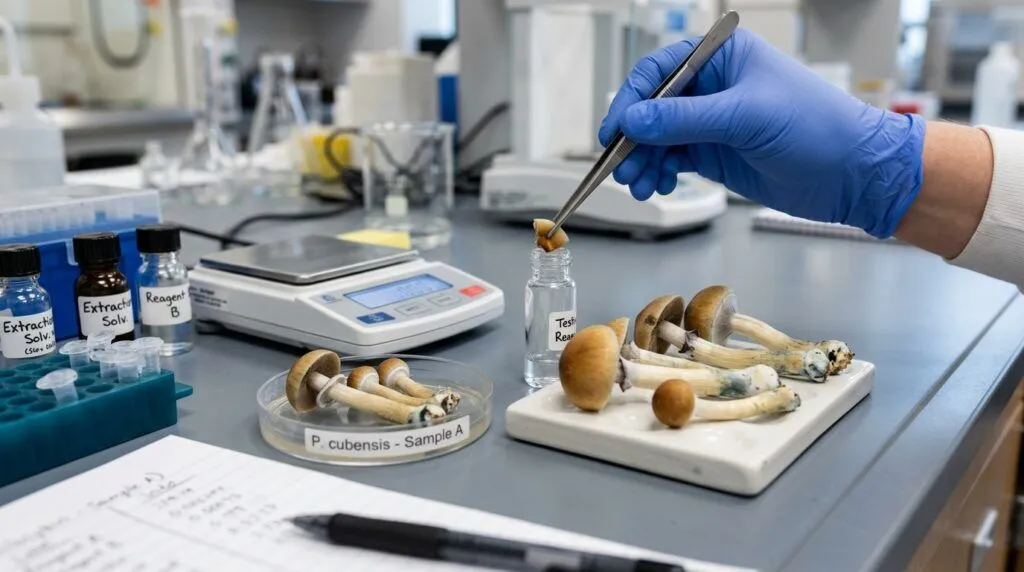
The Technologies That Power Modern Scientific Discovery
Every scientific discovery begins with one essential requirement: accurate and reliable measurement. In psychedelic science, researchers investigate extraordinarily complex biological molecules that often exist in minute quantities within plants, fungi, microorganisms, and laboratory synthesized materials. Determining their identity, structure, concentration, purity, and chemical behavior requires analytical technologies capable of examining matter at the molecular level with exceptional precision. Over the past century, laboratory instrumentation has transformed scientific research by allowing investigators to observe chemical and biological systems with levels of accuracy that were previously unimaginable. Today, these technologies form the foundation of modern analytical chemistry, pharmacology, molecular biology, neuroscience, and natural product research.
Rather than relying on a single analytical instrument, contemporary laboratories combine multiple complementary techniques to answer different scientific questions. One method may separate complex mixtures into individual components, another may determine molecular weight, while a third reveals three dimensional molecular structure or identifies specific chemical bonds. Scientists integrate data from numerous analytical platforms to construct a comprehensive understanding of each compound under investigation. This multidisciplinary analytical approach has become one of the defining strengths of modern laboratory science, ensuring that scientific conclusions are supported by multiple independent sources of evidence rather than a single experimental observation.
Chromatography: Separating Complex Chemical Mixtures
One of the most fundamental analytical techniques in modern chemistry is chromatography, a family of laboratory methods designed to separate complex mixtures into their individual chemical components. Biological samples collected from plants, fungi, or laboratory syntheses often contain hundreds or even thousands of different molecules. Chromatographic techniques allow researchers to isolate these compounds so that each can be examined individually with remarkable accuracy.
Among the most widely used methods is High Performance Liquid Chromatography (HPLC), which separates compounds according to their interactions with specialized stationary and mobile phases under carefully controlled conditions. HPLC is extensively employed in natural product chemistry, pharmaceutical analysis, and quality assurance because it provides highly reproducible measurements of chemical composition and purity. Another important technique is Gas Chromatography (GC), which analyzes volatile compounds by transporting them through a heated analytical column using an inert carrier gas. Together, these chromatographic methods provide the essential first step for many advanced laboratory investigations.
Mass Spectrometry: Identifying Molecules With Exceptional Precision
After compounds have been separated, scientists often employ Mass Spectrometry (MS) to determine their molecular identity. Mass spectrometers convert molecules into charged particles called ions before measuring their mass to charge ratios with extraordinary accuracy. This process produces a molecular fingerprint that allows researchers to identify unknown compounds, verify chemical structures, and measure extremely small concentrations within highly complex biological samples.
Modern laboratories frequently combine chromatography with mass spectrometry to create integrated analytical systems such as Liquid Chromatography Mass Spectrometry (LC-MS) and Gas Chromatography Mass Spectrometry (GC-MS). These powerful platforms unite the separation capabilities of chromatography with the molecular identification capabilities of mass spectrometry, enabling scientists to investigate complex natural products with remarkable sensitivity and reliability. Such technologies have become indispensable across medicinal chemistry, metabolomics, environmental science, forensic chemistry, and pharmaceutical research.
Nuclear Magnetic Resonance and Structural Chemistry
While chromatography and mass spectrometry identify molecules and measure their abundance, Nuclear Magnetic Resonance (NMR) Spectroscopy provides detailed information about molecular structure. NMR uses strong magnetic fields and radiofrequency energy to examine the atomic environment surrounding specific nuclei within a molecule. By analyzing these interactions, chemists can determine how atoms are connected, identify functional groups, and reconstruct complete molecular architectures without altering the sample itself.
NMR has become one of the most valuable tools in organic chemistry because it allows researchers to confirm molecular structures with exceptional confidence. Combined with complementary analytical techniques, NMR supports natural product discovery, synthetic chemistry, structural biology, and pharmaceutical research while providing essential evidence for scientific publications and regulatory documentation.
Spectroscopy and Molecular Characterization
Spectroscopy encompasses several analytical methods that investigate how molecules interact with different forms of electromagnetic radiation. Infrared Spectroscopy (IR) identifies characteristic chemical bonds by measuring how molecules absorb infrared light, providing valuable information about functional groups and molecular composition. Ultraviolet Visible Spectroscopy (UV-Vis) measures the absorption of ultraviolet and visible wavelengths to investigate electronic properties and quantify specific compounds within solution.
For investigations requiring atomic level structural detail, researchers often employ X-ray Crystallography, a technique capable of determining the three dimensional arrangement of atoms within crystalline materials. By analyzing diffraction patterns generated when X-rays interact with carefully prepared crystals, scientists can construct highly accurate molecular models that reveal atomic positions with remarkable precision. These structural insights are fundamental to medicinal chemistry, molecular biology, and pharmaceutical development.
Integrating Advanced Technologies for Comprehensive Analysis
Modern laboratory science rarely relies on a single analytical instrument. Instead, researchers integrate chromatography, spectroscopy, crystallography, computational chemistry, genomics, metabolomics, and bioinformatics into comprehensive analytical workflows capable of examining biological systems from multiple perspectives. Artificial intelligence and machine learning further strengthen these investigations by assisting scientists in processing enormous datasets, identifying hidden patterns, and developing predictive models that improve experimental interpretation.
This integrated approach significantly enhances scientific confidence because conclusions are supported by multiple independent analytical techniques. When chromatography, mass spectrometry, NMR, spectroscopy, and computational analysis all produce consistent evidence, researchers can interpret findings with substantially greater certainty than would be possible through any individual method alone.
Why Laboratory Techniques Matter
The extraordinary progress achieved in psychedelic science over recent decades would not have been possible without the continual advancement of laboratory technology. Every improvement in analytical instrumentation has expanded the ability of researchers to investigate molecular structure, chemical composition, biological pathways, and evolutionary relationships with increasing accuracy. These technologies have transformed laboratory science from simple chemical observation into an interdisciplinary discipline capable of exploring the molecular foundations of life itself.
As future innovations continue emerging through artificial intelligence, quantum sensing, automated robotics, high resolution imaging, and next generation analytical chemistry, laboratory science will become even more powerful. For students and readers seeking to understand psychedelic research, appreciating the technologies behind scientific discovery is just as important as understanding the discoveries themselves. The instruments used in today’s laboratories are not merely tools; they are the foundation upon which reliable scientific knowledge is built, validated, and continually refined.