
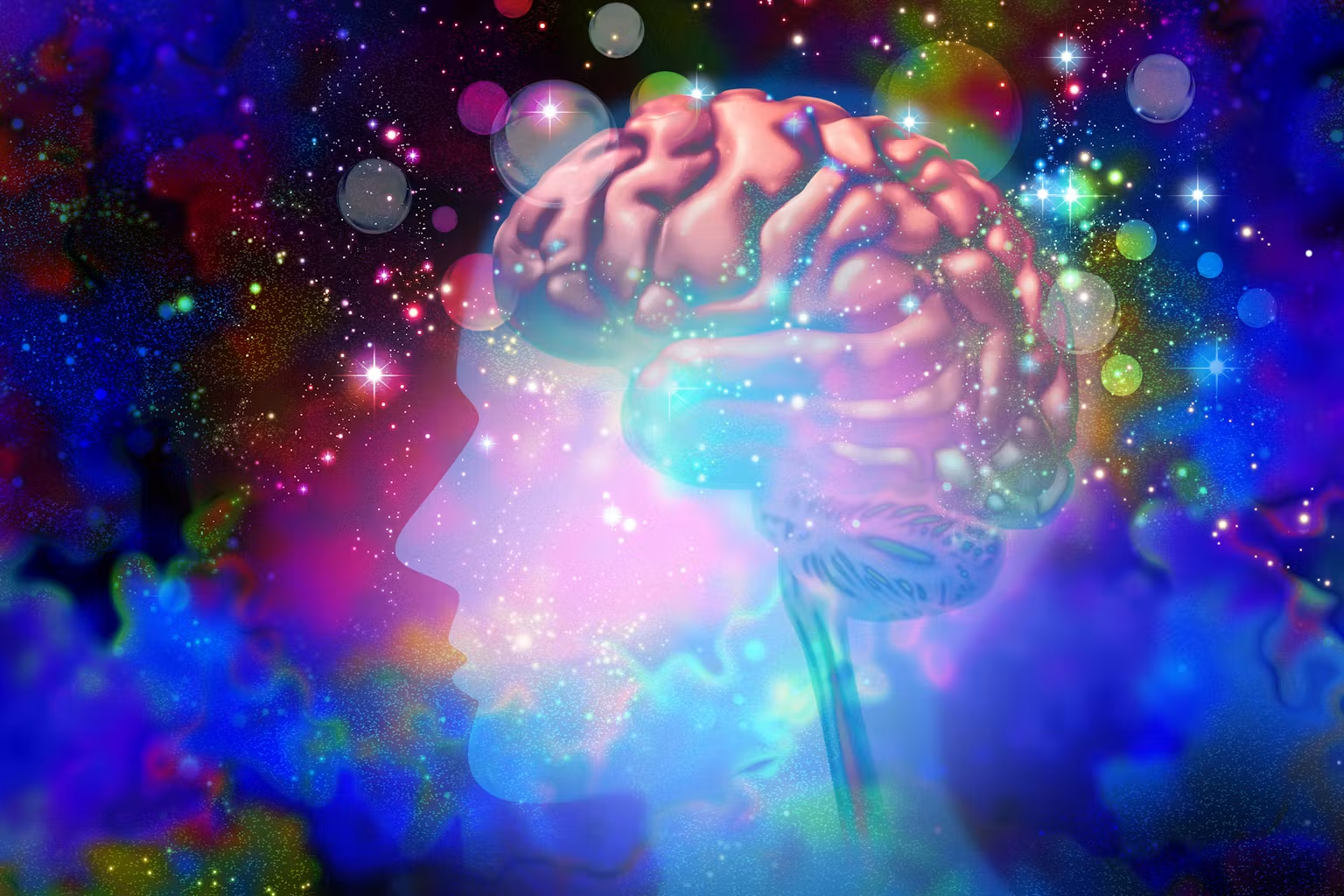
The Human Brain: One of Science’s Greatest Frontiers
The human brain is the most intricate biological structure known to science. Composed of approximately 86 billion neurons connected by trillions of synapses, it coordinates every thought, memory, emotion, sensation, and movement throughout life. Despite centuries of scientific investigation, researchers continue to uncover new insights into how the brain processes information, adapts to changing environments, and generates conscious awareness. Every technological advancement, from high-resolution neuroimaging to molecular genetics, reveals another layer of complexity, demonstrating that the brain remains one of biology’s greatest unsolved puzzles.
In recent decades, psychedelic research has become an increasingly important part of this broader scientific journey. Rather than viewing psychedelic compounds solely as isolated chemical substances, neuroscientists study them as tools for investigating the fundamental principles of brain organization and communication. By examining how these compounds interact with specific neurotransmitter systems under carefully controlled research conditions, scientists are gaining valuable insight into neural connectivity, cognitive processing, perception, and the remarkable adaptability of the nervous system. This interdisciplinary approach continues to expand scientific understanding while contributing to the wider field of neuroscience.
Mapping the Networks That Shape Human Thought
Modern neuroscience has shifted away from viewing the brain as a collection of isolated regions responsible for individual tasks. Instead, scientists now understand that cognition emerges through dynamic communication between large-scale neural networks that constantly exchange information. Memory, attention, language, emotional regulation, sensory integration, and decision-making all depend upon coordinated activity across multiple interconnected regions rather than any single location within the brain.
Psychedelic research has contributed significantly to this evolving perspective by helping scientists investigate how communication between these networks changes during controlled experimental studies. Advanced imaging technologies allow researchers to observe functional connectivity across the living brain, revealing patterns that continue to refine scientific models of perception, cognition, and conscious experience. These findings are not viewed in isolation but contribute to a growing body of knowledge that benefits neuroscience as a whole.
Neurotransmitters and the Language of the Brain
Every thought and action depends upon billions of microscopic chemical signals travelling between neurons. These signals are carried by neurotransmitters, molecules that bind to specialized receptors and regulate communication throughout the nervous system. Different neurotransmitter systems influence different aspects of brain function, including learning, attention, mood, sensory processing, motivation, and memory. Understanding these complex interactions has become one of the primary goals of modern neuropharmacology.
Many classic psychedelic compounds are studied because of their interaction with serotonin receptors, particularly the 5-HT2A receptor, which plays an important role in neural signaling and information processing. Researchers investigate these molecular interactions to better understand how receptor activity influences communication across distributed brain networks. This work continues to improve scientific understanding of receptor biology while providing valuable insight into the mechanisms that support normal brain function.
Technology Is Transforming Brain Research
The rapid development of scientific technology has fundamentally changed how researchers investigate the human brain. Functional magnetic resonance imaging (fMRI), electroencephalography (EEG), magnetoencephalography (MEG), positron emission tomography (PET), and other advanced techniques enable scientists to observe neural activity with remarkable precision. Rather than relying solely on behavioural observations, researchers can now compare subjective experiences with measurable biological data, producing a more complete understanding of brain function.
These technologies generate enormous volumes of information that are increasingly analysed using artificial intelligence, computational neuroscience, and advanced statistical modelling. Together, these innovations allow scientists to identify subtle patterns of neural communication, compare findings across multiple studies, and develop increasingly sophisticated models of cognition and consciousness. The combination of experimental neuroscience and computational analysis continues to redefine what is possible in brain research.
A Collaborative Future for Neuroscience
Understanding the brain requires collaboration across numerous scientific disciplines. Neuroscientists, pharmacologists, psychologists, chemists, molecular biologists, geneticists, computer scientists, mathematicians, and medical researchers each contribute unique expertise that helps answer increasingly complex questions. This multidisciplinary approach has become one of the defining strengths of contemporary neuroscience, enabling discoveries that would be impossible through any single field alone.
As scientific knowledge continues to expand, research into brain function is expected to become even more integrated with emerging technologies, including machine learning, genomics, molecular imaging, and computational biology. These advances promise to deepen our understanding of how billions of neurons work together to produce perception, learning, memory, and conscious awareness. Through careful scientific investigation and international collaboration, researchers continue to move closer to understanding one of the greatest mysteries in biology—the extraordinary complexity of the human brain.